Tuesday, 7 March 2017

Quality of education (II. part)


Once we realize the traps, we can devote time to advantages of ICT use.

Cognition

Classroom consists of a myriad of different intelligences. Teaching staff undoubted strive to maximize the development of all of them, which is no easy task. One of ICT advantages is representing and reaching information in diverse ways. I am not talking only about diverse teaching methods and styles but also about moving boundaries in dimension of knowledge in various fields. Knowledge that were once considered extraneous can now be presented in different ways. We can activate different senses, engage students and simulate experience in order to activate cognitive development.

How can iPad Can Transform Classrooms?
(http://langwitches.org/blog/2012/08/07/there-is-more-to-ipads-in-the-classroom-than-apps/, 7.3.2017)


Many researches were made about brain activation and of course, all information are available online. It looks like teachers can’t any more have excuses. Stimulating specific brain and qualitatively improving cognition is achievable with some effort and….using ICT.  


Dellit, J. (2009). Using ICT for Quality in Teaching- Learning Evaluation Processes. Retrieved from http://www.ictliteracy.info/rf.pdf/UsingICTQuality.pdf.


Quality of education


Last day I was talking with my cousin (15 years old, secondary school)…

 “We were using computers for learning about cell division. We were able to search information on our own, at the end we only needed to fill the worksheet. Our biology lessons are always fun.”

And it made me think…

Well, no doubt, it was fun; the children have had free hands on using network during classes. But it was also instructive? The use of ICT in education contains many pitfalls that need to be made aware.
  1. Use of ICT can give unnecessary information.
  2. Use of ICT can be time-consuming if not well planned.
  3. Use of ICT can increase differences in learning (among students).

And to sum up these findings: Use of ICT does not automatically add quality!


Wednesday, 22 February 2017

Technology‑based learning environments

Educational systems are striving for continuous improvement, or at least they should. And many times are those improvement based on (new) technology.
“Technology can shape, and reshape, who is the learner and who is the teacher. It can open up knowledge and content that otherwise would be less accessible" (Groff, 2013, p.2).

New but old?
(http://www.uspeak.academy/en/news/16-new-but-old-trend-in-education, 22.02.2017)

There comes a question how to ‘adopt’ the new learning environments. Well I see two options. We can start from the beginning and reinvent learning environments, setting the ground on ICT. Or we can integrate ICT in the current learning process, which in practice means gradually adding new technology. My educational process was part of the second option, which I still see as more accessible. As Jessica Groff (2013) is saying, implementing new technologies and ICT based pedagogies with the old ones is less likely to encounter resistance from the current system. In addition, the teachers see it as less intrusive because it still allows them to find their way inside it. On the other hand, reinventing learning environments is showed as more successful way for ICT use.
There is no doubt that both ways are changing current teaching methods and they are redesigning learning environments as well. Since transformation must be well thought maybe we should change the foundations, to reach full potential and to create a solid basis on which we can build further.


Groff, Jennifer (2013). Technology-rich innovative learning environments. Retrieved from https://www.oecd.org/edu/ceri/Technology-Rich%20Innovative%20Learning%20Environments%20by%20Jennifer%20Groff.pdf

Monday, 20 February 2017

The differences between home and school use of ICT


Despite the promotion of the ICT use, school is often creating limits and restrictions about it. Slow access, filtering system, boring ICT based assignments and teacher’s lack of technology skills are just some of the barriers that hinder the student's work. Students nowadays poses extensive internet skills, they come to school with expectations, experiences and skills that many times are not recognised in the classroom.


The digital disconnect

Inside Pew Internet & American Life Project there has been made a study Widening gap between internetsavvy students and their schools, 2002 in which the authors Douglas Levin and Sousan Arafeh named mismatch between home and school use of ICT as “The digital disconnect”.

“Many schools and teachers have not yet recognized—much less responded to—the new ways students communicate and access information over the Internet. (Levin and Arafeh, 2002).

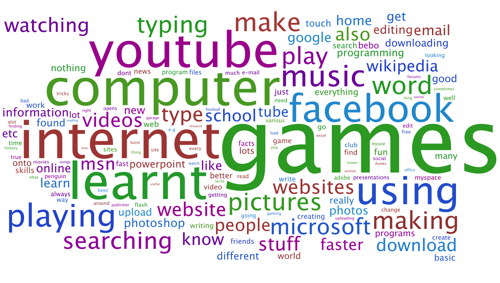
Teacher policies about internet use are many times completely different to the student’s home-use of internet. Nevertheless, I am sure the biggest part of ICT use (for educational or non-educational purposes) is still taking place at home. Which side should therefore adapt? Well, maybe we can find the middle way. As the study reports students want better coordination of their out-of-school educational use of the Internet with classroom activities. They argue that this could be the key to leveraging the power of the Internet for learning. For this purpose, teachers should be equipped with a sufficient amount of knowledge on the use of ICT and that primarily we should give lessons about the use of ICT to teachers. Only with that, we can assure high-quality online information for students to complete school assignments, information which will be placed in the direction of healthy use of the Internet. Of course, assignments have to be set engaging as well. Use of the Internet contains many pitfalls; students can quickly lose focus and the red thread if assignment does not draw them.  

What is your favourite thing you do with technology at home?
(http://milesberry.net/2009/01/informal-learning-wordles/, 20.2.2017)


Levin, D. and Arafeh, S. (2002). The digital disconnect: The widening gap between internetsavvy students and their schools. Retrieved from http://immagic.com/eLibrary/ARCHIVES/GENERAL/PEW/P020814.pdf.

Saturday, 18 February 2017

For introduction


They say life begins at the end of our comfort zone and that in the end we only regret the chances we did not take. Therefore, I decided to expand my world and go study abroad. So here I am, in beautiful Cadiz, enjoying my last days of unforgettable Erasmus exchange.


However, I still have some work to do before I leave. Last subject left me with an interesting assignment to do – to write a blog about course content. Perhaps not even so unusual way to demonstrate what we have learned. After all, we live in the information era of the 21st century.

An open world begins with an open mind.
(https://www.linkedin.com/pulse/open-world-begins-mind-rashmi-vikram, 18.02.2017)